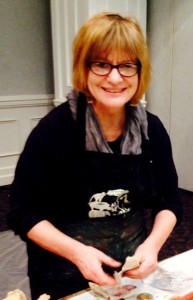
About Serena
Serena Barton blends her long career as a Licensed Counselor with her passion for art. Visual art was her first love as a child. Eventually this gave way to theater, then to her work as a counselor and raising children.
Serena rediscovered her desire to make art after her first trip to Italy. She taught herself to paint and create mixed media work in her forties, earning her the right to insist that it is never too late to delve into what inspires us.
Serena continues to show and sell her work in galleries and online. Her business, 'The Art of Your Life' provides creativity/art workshops and individual, couple, and family counseling. Serena teaches classes on women and art in the Women's Studies Program at Portland State University. She lives in Portland, Oregon.
Interview: Sitting Down with Serena Barton
by Sue Favin Smith
January 26, 2008 (Re-printed from ancientartist.typepad.com)
Today I would like to introduce you to Serena Barton. Serena first contacted me because she felt a connection: "I am so happy to discover your blog. I am an ancient artist as well, also living in Oregon. I started making art (for real) at age 47 and am now well over 50, closer to 60." I think you'll find this talented, original artist as fascinating as I did.
Tell us a little about yourself.
I am a native Oregonian and grew up in Eugene. My partner and I have lived in Portland for 23 years. My partner is a writer and American Sign Language Interpreter, I have two grown children, one of whom is an artist, and I have an 8 year old grandson who has his own etsy shop, although he has lost interest in stocking it, preferring to make messy scientific experiments.
I have my own business called "The Art of Your Life." This includes licensed professional counseling, facilitating creativity workshops, and holding a First Friday art opening at my office/studio. I also teach part time in the Portland State University's Women's Studies Program. I teach a 4 credit class called "Women, Creativity, and Healing," and a variety of weekend 1 credit classes on women artists. Oh yeah, I also make art, show it, and when possible, sell it.
When did you realize you wanted to be an artist, and when did you seriously begin working toward your goal?
Art was my first love. As a young child, I pored over my grandmother's books filled with art prints. My early exposure to the work of the old masters and the Impressionists taught me to see. At age four, I won a prize in the local children's Pet Parade for my tricycle float, which was decorated with my drawings. My father, a commercial artist, encouraged me in my efforts. In elementary school, teachers praised the "personality" they saw in my work. This bliss ended in junior high, when I got a "C" in art because I couldn't draw an accurate floor plan.
In adulthood I became a psychotherapist and mother of two children. I explored a variety of crafts, such as weaving, but they were too exacting for my extremely right brain style. In 1990 I started decorative surface design. By 1994 the pillow covers I was making began to look suspiciously like paintings. After a life-changing trip to Italy the following year, I switched to oil and canvas. Since that time, I've devoted as much time as possible to making art. I've immersed myself in art history, and often portray artists of the past in my work.
What do you consider your greatest accomplishment so far?
A highlight of my career was a show and lecture I gave in Bologna, Italy, the birthplace of many famous women artists in the Renaissance and Baroque periods. I consider my greatest accomplishments so far are that I restarted art in midlife, I have kept at it passionately, and that I have discovered a talent for helping others do the same.
On your blog you talk about being inspired by close-up photographs in art restoration books. Can you talk more in depth on this inspiration?
I love to read about art restoration and conservation. I think I like the detective aspect of it ( I love mysteries.) X-rays show mistakes by famous painters that they chose to cover up or ways they altered their painting as it progressed. I like to see how the restorers work to make the painting "new" again without being false to the original. I bought a book on sale a few years ago called "The Restoration of Paintings." I think it is a textbook for restoration students. Now, I could never be an art restorer or conservator. They have to know chemistry and stuff like that and they have to be very exacting. I just like to read about it. So, this book has a lot of close-up pictures of problems with paintings -- everything from tears, flaking paint, canvas unraveling, to infestation with icky vermin. Not appealing, but the pictures were beautiful. So I used the colors and compositions as an inspiration for a series of encaustic paintings. I titled them with reference to the restoration problems, but then also, to psychological issues, as therapy involves restoration as well.
I love the way you are so visually stimulating with mixed media and unique formats. What are your favorite materials to work with and why?
It's hard for me to pick a favorite. I love the feel and glow of oil paint on wood and canvas and love to use oil glazes as the finishing touch on paintings. I'm now doing some painting with acrylic because it dries faster and is easier to use when I have limited time. I love encaustic -- the smell, the translucence, the unexpected discoveries -- everything. Finally, I love collage and mixed media for the excitement of layering and putting pieces together whatever way I want, and how the layering evokes the layering of history and the seasoning and burnishing of human beings as they grow and age.
Where did the idea of the Renaissance influence come from? What does this theme mean to you? You say that even your still life work has personality -- can you talk more about this inspiration?
I love history and have since I can remember. I first looked at prints of Renaissance Art and Impressionist art as a child, and when I started to paint as an adult these were the influences that came out in my work. I think modern clothing is very practical and very boring. I like period clothes because they are more beautiful and make the people wearing them more mysterious than they would be dressed in sweats and a T-shirt. I love the Renaissance emphasis on beauty and humanity. Of course for me, my own renaissance was when I was reborn as an artist. My favorite art of any period incorporates a magic and often breathtaking quality that makes me glad I'm alive. That doesn't mean art has to be happy, happy. Just that there's something about it that makes me feel more alive...as far as personality, I guess it's a combination of not being able to draw precisely and of being able to see the aliveness in everything.
What do you think has been the most beneficial to you in finding your artistic voice? And what do you wish someone had told you when you first began your art career that would have helped you the most?
One beneficial thing is that I started making art as an adult after I had found my own voice in my life. Like many of us, I had a strong sense of myself when I was a small child but had lost it on the way to adulthood. Doing my own therapeutic work allowed me to re-connect with the 4-year old who decorated the Pet Parade float. I could again feel that excitement and confidence. Another part of this evolution was that I gained an ability to see in a different way. My vision was clearer, metaphorically and in practice. The other great thing is working to keep full of inspiring things to see, do, smell, taste, hear, and feel. Sometimes I misplace my vision and my voice for a while but it always returns even stronger.
What I would tell someone beginning a career would be: Keep at it, learn about the cycle of creativity so that creative blocks won't throw you, seek out support and networking, develop a thick skin, have another source of income if you need it, so your art work doesn't start to feel like just work, learn how to market, look at lots of art, and take good care of yourself.
